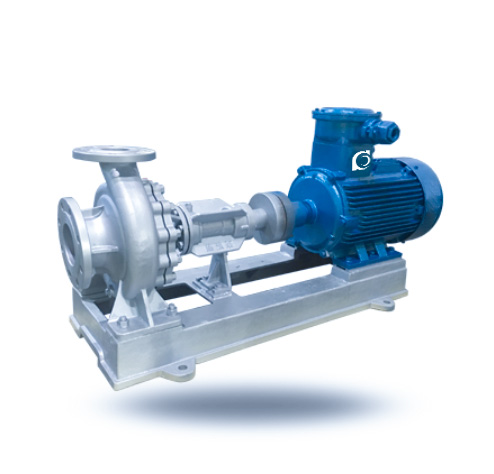
Product Overview
The LQRY Stainless Steel Hot Oil Pump is developed based on the design concepts of modern thermal oil circulation pumps, incorporating advanced technology. It is compact, technically sophisticated, highly efficient, and ensures long-term stable operation without leakage. This pump operates efficiently without the need for an auxiliary cooling system, ensuring safety, reliability, and economic performance. It can handle a maximum operating temperature of 370°C, making it ideal for high-temperature heat transfer fluid circulation in industries such as oil, boiler systems, construction, road maintenance, pharmaceuticals, plastics, rubber, textiles, and printing and dyeing.
Model Designation

Specifications & Installation
Outline Drawing

Performance Data
| 1 | Pump Body | 2 | Cap Nut | 3 | Impeller | 4 | Plug | 5 | Thermal Ring | 6 | Flat Key |
| 7 | Pump Cover | 8 | Elastic Ring | 9 | Aluminum Gasket | 10 | Pressure Ring | 11 | Gasket | 12 | Nut |
| 13 | Washer | 14 | Bolt | 15 | Bolt | 16 | Pump Shaft | 17 | Ball Bearing | 18 | Bearing Seat |
| 19 | Gasket | 20 | Aluminum Nameplate | 21 | Rivet | 22 | Mechanical Seal | 23 | Bolt | 24 | Support Foot |
| 25 | Gasket | 26 | Oil Guide Pipe | 27 | Screw | 28 | Gasket | 29 | Rubber Seal | 30 | Bearing Cover |
| 31 | Gasket | 32 | Pump Coupling | 33 | Flat Key | 34 | Elastic Block | 35 | Motor Coupling | 36 | Cover |
| 37 | Screw | 38 | Motor | 39 | Bolt | 40 | Bolt | 41 | Gasket | 42 | Base |
| 43 | Gasket | 44 | Elastic Stop Ring | 45 | 46 | 47 | 48 |
Operating Manual
Installation & Requirements
-
The quality of installation plays a crucial role in the smooth operation and service life of the LQRY stainless steel thermal oil pump, so the installation work must be done carefully and without haste.
-
The suction pipe height, length, and diameter should meet the calculated values. Keep the installation as short as possible to reduce unnecessary losses (such as elbows, etc.).
-
The suction and discharge pipelines should be supported by pipe racks, and the pump should not bear the weight of the pipeline.
-
The installation location of the pump should be spacious enough to facilitate maintenance and provide good heat dissipation.
Installation Procedure
-
Place the unit on a foundation with anchor bolts, placing matching shims between the base and foundation for alignment, then tighten the anchor bolts.
-
Loosen the coupling, use a level to check the alignment of the pump shaft and base, adjust the wedges to level, then tighten the anchor bolts to prevent movement.
-
Pour concrete to set the base and anchor bolts.
-
After the concrete has hardened, check if the base and anchor bolts are loose or defective. Tighten the anchor bolts and recheck the pump’s level.
-
Check the coaxiality between the pump shaft and motor shaft. The allowable deviation on the coupling outer circle is 0.1mm, and the gap between the two coupling faces should be 2-3mm, with the maximum and minimum gap difference not exceeding 0.3mm.
-
After connecting the piping and ensuring the correct direction of the motor, reconnect the coupling and check coaxiality again.
-
After the actual trial run for 3-4 hours, check again. If no abnormal conditions are found, the installation is considered successful.
-
During installation, to prevent debris from entering the machine, cover all holes and ensure proper cleaning of the inlet and outlet pipes before operation. Install a filter on the pump inlet to prevent foreign objects from entering the pump.
OEM & Custom
We offer OEM branding, stainless-steel versions, PTFE upgrade seals, high-temperature models, custom bases, flange standards, voltage options, and export-grade packaging for international buyers.
FAQs
- 1. What is the maximum working temperature?
The pump handles up to 370°C; special materials can reach higher ranges. - 2. Does the pump require cooling water?
No. LQRY uses a self-radiation design and does not need external cooling. - 3. What industries commonly use this pump?
Petroleum, chemical, textile, rubber, plastic, boilers, and dyeing systems. - 4. What seal types are included?
High-temperature packing seal + mechanical seal + PTFE lip seal. - 5. How should the system be preheated?
Increase temperature slowly until water vapor is fully removed; casing ≥40°C. - 6. What maintenance is required?
Bearings need service every 3,000 hours; check alignment, vibration and leakage. - 7. Can OEM customization be provided?
Yes, including materials, seals, voltage, flanges, and special temperature configurations.