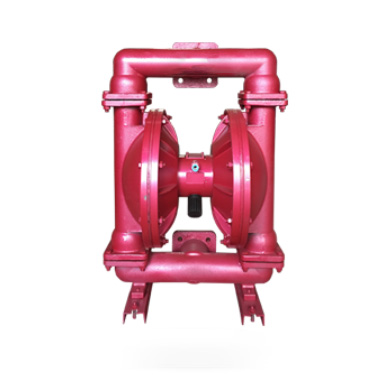
Product Overview
The QBY Air-Operated Diaphragm Pump is a positive displacement pump driven by compressed air, designed for pumping corrosive liquids, media containing solid particles, high-viscosity liquids, and highly toxic, flammable, and volatile liquids. The pump operates without electricity, providing safe and reliable performance in demanding and hazardous operating conditions. It is widely used in applications requiring explosion-proof features and high self-priming capabilities.
Model Designation

Key Features
-
Air-Driven Operation: Prevents overheating during operation, ensuring stable and reliable pump performance.
-
No Spark Risk: Suitable for use in flammable and explosive environments, ensuring safe operation.
-
Handles Solid Particles: Capable of pumping media containing solids with low clogging tendencies, ensuring continuous flow.
-
Low Shear Delivery: The pump’s low shear design ensures the continuous transport of shear-sensitive materials without degradation.
-
Self-Priming Ability: The pump has excellent self-priming capabilities, suitable for various media conditions.
-
Waterproof and Versatile: Can be used in underwater applications, offering additional flexibility for unique operational environments.
Engineering Overview
The QBY series operates by reciprocating diaphragm movement to transfer media, ensuring complete liquid discharge and stable operation. The pump housing and diaphragm materials can be selected according to the properties of the media being pumped, making the pump highly adaptable in applications where traditional pump types are unsuitable.
Typical Applications
The QBY Air-Operated Diaphragm Pump is widely used in the following industries:
-
Food Processing: Transports food adhesives, emulsions, and other viscous substances.
-
Chemical Industry: Used for transferring coatings, emulsions, wastewater, and slurry.
-
Mining and Construction: Ideal for transferring mining slurry, sand, and other solid-laden fluids.
-
Environmental Protection and Marine Operations: Handles wastewater and other pollutants in environmental and marine applications.
-
Other Industries: Handles a wide range of chemicals, including corrosive or hazardous liquids.
System Configuration
Pump Components
The QBY diaphragm pump consists of a pump body, diaphragm assembly, pneumatic drive unit, and intake/discharge check valves. The pump body is made from materials such as polyethylene, engineering plastics, aluminum alloy, cast iron, stainless steel, or titanium alloy. The diaphragm materials include NBR, CR, FKM, PTFE, and other fluoroplastics, compatible with a variety of media.
Components and Supply
The QBY diaphragm pump is equipped with essential components that ensure durability and reliability, including the diaphragm, drive unit, and intake/discharge check valves. These parts can be customized according to the specific media and operational requirements, ensuring optimal performance in demanding environments.
Technical Service
QBY pumps offer comprehensive technical support, including installation, commissioning, regular maintenance, and troubleshooting services, ensuring the long-term stability and reliability of the equipment.
Operating Conditions
-
Power Source: Compressed air.
-
Applicable Media: From low to high viscosity liquids, media with particles, corrosive and hazardous substances.
-
Maximum Medium Temperature: Up to 150°C for special requirements.
-
Back Pressure: The pump is suitable for high back-pressure conditions; when the discharge outlet is closed, the pump will automatically stop and restart when the flow is restored.
Service Conditions
Regular inspection of the pump’s sealing system, diaphragm, and pneumatic drive components is recommended to ensure the pump operates efficiently and safely over time.
Protection Features
The QBY diaphragm pump is equipped with multiple protection features, including overcurrent protection, temperature monitoring, and liquid level protection systems, ensuring the pump can stop operating in abnormal conditions to prevent equipment damage.
Selection Standards
When selecting the pump model, consider the temperature of the media, pH value, solid particle size, viscosity, and the required flow and head of the pump, ensuring the selection of the most suitable configuration.
Specifications & Installation
Outline Drawing

Performance Data
| No. | Name | No. | Name |
| 1 | Air Inlet | 7 | Connecting Rod |
| 2 | Air Valve Body | 8 | Rod Copper Sleeve |
| 3 | Air Valve | 9 | Center Bracket |
| 4 | Ball | 10 | Pump Inlet |
| 5 | Ball Seat | 11 | Air Outlet |
| 6 | Diaphragm |
Performance Parameters
| Model | Flow (m³/h) | Head (m) | Outlet Pressure (kgf/cm²) | Suction Lift (m) | Max Particle Diameter (mm) | Air Supply Pressure (kgf/cm²) | Air Consumption (m³/min) | Material | |||
| Aluminum Alloy | Stainless Steel | Cast Iron | Polypropylene | ||||||||
| QBY-10 | 0–0.8 | 0–60 | 6 | 5 | 1 | 7 | 0.3 | ★ | ★ | ★ | ★ |
| QBY-15 | 0–1 | 0–60 | 6 | 5 | 1 | 7 | 0.3 | ★ | ★ | ★ | ★ |
| QBY-25 | 0–2.4 | 0–60 | 6 | 7 | 2.5 | 7 | 0.6 | ★ | ★ | ★ | ★ |
| QBY-40 | 0–8 | 0–60 | 6 | 7 | 4.5 | 7 | 0.6 | ★ | ★ | ★ | ★ |
| QBY-50 | 0–12 | 0–60 | 6 | 7 | 8 | 7 | 0.9 | ★ | ★ | ★ | / |
| QBY-65 | 0–16 | 0–60 | 6 | 7 | 8 | 7 | 0.9 | ★ | ★ | ★ | / |
| QBY-80 | 0–24 | 0–60 | 6 | 7 | 10 | 7 | 1.5 | ★ | ★ | ★ | / |
| QBY-100 | 0–30 | 0–60 | 6 | 7 | 10 | 7 | 1.5 | ★ | ★ | ★ | / |
Material Properties
| Nitrile Rubber (NBR) | Neoprene Rubber (CR) | Fluororubber (FKM) | PTFE | Food-Grade Rubber | |
| Fuming Nitric Acid | × | × | △ | △ | |
| Concentrated Nitric Acid | × | × | △ | △ | |
| Concentrated Sulfuric Acid | × | × | ○ | △ | |
| Concentrated Hydrochloric Acid | × | △ | △ | △ | |
| Concentrated Phosphoric Acid | × | △ | △ | △ | |
| Glacial Acetic Acid | × | × | × | △ | |
| Concentrated Sodium Hydroxide | ○ | ○ | △ | △ | |
| Anhydrous Ammonia | △ | △ | △ | △ | |
| Dilute Nitric Acid | × | × | ○ | △ | |
| Dilute Sulfuric Acid | △ | △ | △ | △ | |
| Dilute Hydrochloric Acid | × | ○ | △ | △ | |
| Dilute Phosphoric Acid | × | × | △ | △ | |
| Dilute Sodium Hydroxide | ○ | ○ | △ | △ | |
| Ammonia Solution | △ | △ | × | ||
| Benzene | × | × | ○ | ○ | |
| Gasoline | ○ | ○ | ○ | ○ | |
| Petroleum | △ | × | ○ | ○ | |
| Carbon Tetrachloride | ○ | ○ | ○ | ||
| Carbon Disulfide | ○ | × | ○ | ||
| Ethanol | ○ | ○ | ○ | ○ | |
| Acetone | × | △ | × | ○ | |
| Cresol | × | △ | △ | ○ | |
| Acetaldehyde | × | × | △ | ○ | |
| Ethylbenzene | × | × | △ | ○ | |
| Acrylonitrile | △ | △ | × | ○ | |
| Butanol | ○ | ○ | ○ | ○ | |
| Butadiene | ○ | × | △ | ○ | |
| Styrene | × | × | △ | ○ | |
| Ethyl Acetate | × | × | × | ○ | |
| Ether | × | × | × | ||
| Note: ○ — long service life; △ — average service life; × — not recommended. This table considers only corrosion resistance. Since PTFE has lower elasticity than rubber, actual service life will also be affected by pressure, pump stroke, impurities in the medium and other factors. Food-grade rubber is used specifically for food and beverage applications. |
|||||
Operating Manual
Application Examples
-
Cleaning Tank Bottoms: Even with water padding, conventional methods cannot completely empty the oil. For a 5000 m³ tank, typically 1–1.5 tons of oil remains. For tanks with a low-level drain, residual oil and water can be discharged to an oily wastewater treatment plant, but most light components volatilize during transfer, causing environmental pollution. A diaphragm pump greatly improves recovery efficiency.
-
Temporary Tank Transfer, Loading/Unloading, and Sampling: In refinery operations, oil products often need temporary transfer, truck loading, or sampling for analysis. To avoid contaminating permanent pipelines, a diaphragm pump connected to temporary lines can complete these tasks quickly and conveniently.
-
Recovery of Heel Oil in Product Tankers: For a 3000-ton tanker equipped with a fixed screw pump, at least about 50 tons of oil remains between bulkheads. Using a large-displacement diaphragm pump can significantly improve recovery.
-
Transfer of Residual Liquids Containing Gas and Hydrogen Sulfide: Off-gas knock-out drums at refinery flare systems produce sour, corrosive liquids that must be collected and treated, otherwise, they will cause severe acid corrosion to equipment. Diaphragm pumps are suitable for this duty.
-
Ceramic Industry: Used to transfer glaze slurry and to feed filter presses.
-
Dewatering Manholes and Trenches: During maintenance of underground pipelines, valves, and channels, accumulated sewage and oily water must be removed. Submersible pumps can work, but these locations are usually far from power sources. A pneumatic diaphragm pump powered by compressed air cylinders can conveniently recover oily water and dewater the area.
-
Cleaning Wastewater Treatment Basins and Sludge Pits: In wastewater plants, large amounts of oily sludge and silt accumulate and require cleaning. Diaphragm pumps provide flexible, labor-saving, and efficient suction.
-
Draining Sumps in LPG Pump Rooms and Laboratories: These low-lying, hazardous areas are usually classified as high fire-risk zones. Using diaphragm pumps for drainage is safer and much more efficient than water or steam ejectors.
-
Other Uses: QBY pneumatic diaphragm pumps are also advantageous for naphthenic acid transfer, truck loading of sodium sulfite solution, and handling benzene-based raw materials and many other corrosive or hazardous media.
Precautions
-
Vibration of this pump is very light, so foundation bolts are generally not required.
-
If contaminants enter the compressed air supply, pump starting and operation will be affected. It is recommended to install an air treatment unit (filter–regulator–lubricator) in the air line.
-
When handling media that are prone to solidification or freezing, a valve should be installed at the pump inlet. Before stopping the pump, close this valve first, then run the pump for several minutes to discharge the liquid inside, so that the pump can be restarted easily next time.
-
When replacing diaphragms, thoroughly clean the connecting rod and bushings and take care not to damage the white PTFE sealing rings. Reassemble strictly according to the original configuration.
Installation Methods
|

1. This method can be used to transfer liquid from container A to point B.
2. The pump can be immersed directly in the liquid and used as a submersible pump, with the compressed air supply led in through a separate hose.
3. For highly viscous liquids, this method can be used to raise the liquid level so that the medium can be pumped out more easily.
OEM & Custom
Chaodun Pump offers OEM and ODM customization for QBY pneumatic diaphragm pumps, including material selection, diaphragm type, flow configuration, and corrosion resistance customization for specific industrial needs.
FAQs
- Q1: What is the power source of the QBY pump?
It uses compressed air, requiring no electricity, ensuring safety in explosive environments. - Q2: What liquids can it handle?
Corrosive, viscous, flammable, or toxic liquids, as well as slurries and solvents. - Q3: Can it run dry?
Yes, the QBY pump can safely run without damage. - Q4: What materials are available?
Fluoroplastic lined, polypropylene, aluminum, cast iron, and stainless steel. - Q5: Is it suitable for food applications?
Yes, with food-grade rubber diaphragm options. - Q6: Can it be submerged?
Yes, it supports submersible installation and operation. - Q7: Does Chaodun Pump offer OEM customization?
Yes, complete OEM and ODM services for material, flow, and diaphragm configurations.