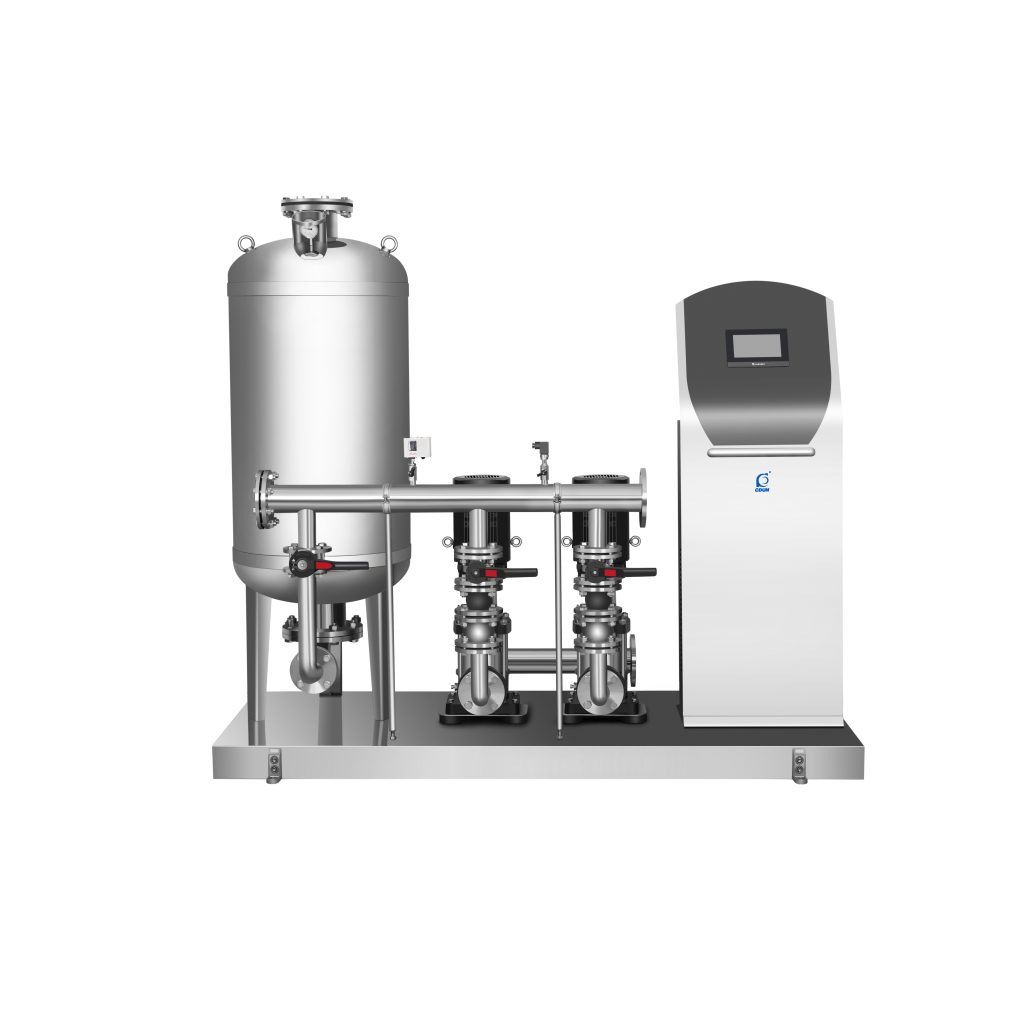
Product Overview
QHYB-CDL Variable Frequency Water Supply System is an integrated constant-pressure booster system based on CDL vertical multistage centrifugal pumps, combined with variable frequency drive, pressure sensor feedback, and PLC intelligent control for automated water supply regulation.
It addresses pressure collapse during peak demand transitions, unstable outlet pressure under simultaneous multi-terminal water consumption, and excessive energy consumption caused by constant-speed pump operation under partial-load conditions.
It is suitable for high-rise residential buildings, community water supply networks, commercial complexes, municipal branch pipelines, and industrial clean water distribution systems requiring stable pressure and dynamic demand response.
Model Designation

Applications
• High-rise building secondary water supply systems
• Residential community domestic water boosting stations
• Commercial building water distribution networks
• Municipal branch pipeline pressure stabilization systems
• Industrial clean water circulation systems
Engineering Advantages
• Multi-pump cascade operation ensures continuous stable pressure under variable demand conditions
• CDL vertical multistage pump hydraulic design provides high head and stable efficiency curve
• Variable frequency drive reduces energy consumption under partial-load conditions
• Closed-loop PID pressure control maintains precise outlet pressure stability
• Modular skid-mounted system simplifies installation and system integration
System Components
QHYB-CDL Variable Frequency Water Supply System mainly includes:
• CDL vertical multistage centrifugal pump units
• Variable frequency drive (VFD) controller
• PLC intelligent control cabinet
• Pressure sensor feedback system
• Stainless steel inlet and outlet manifold
• Check valves and isolation valves
• Base frame and vibration damping system
Technical Parameters
Service Conditions
Clean water without solid particles or fibers
Non-corrosive or mildly corrosive liquids
Indoor pump room installation
Operating Conditions
Flow rate: 5 – 200 m³/h
Head: 20 – 180 m
Power range: 1.5 – 75 kW
Speed: 2900 rpm
Liquid temperature: ≤ 80°C
Working pressure: ≤ 1.6 MPa
Detailed parameter tables are provided below.
How to Select a Pump Model
• Determine peak and average water consumption based on building usage pattern
• Calculate total head including elevation and pipeline resistance loss
• Select pump quantity according to redundancy and reliability requirements
• Define pressure control accuracy and system response time requirements
• Confirm electrical supply and control system integration conditions
Engineering Notes
• Pressure sensor installation position directly affects control stability
• Pump operation should remain within efficient hydraulic range
• Excessive start-stop cycles should be avoided to extend system life
• NPSH conditions must be satisfied to prevent cavitation
Compliance & Quality Assurance
• Factory hydraulic performance testing for each pump unit
• Electrical control system functional testing before delivery
• Material traceability for wetted parts
• Electrical insulation and grounding inspection
• Optional third-party inspection available
Safety Notice
• Do not operate under dry-running condition
• Ensure stable inlet water supply before startup
• Do not exceed rated working pressure
• Disconnect power before maintenance
OEM & Customization
This system supports engineered configuration and duty-based matching. Technical adjustments can be made according to system requirements and installation conditions.
Available options include:
• Pump quantity and cascade configuration
• Motor voltage & frequency
• Control mode customization (VFD / PLC logic)
• Pressure tank integration
• Material selection for wetted components
Configuration is determined based on duty point and project specifications.
FAQs
Q: Can the system maintain constant pressure under variable demand?
A: Yes, PID closed-loop control adjusts pump speed automatically.
Q: What is the maximum working pressure?
A: ≤ 1.6 MPa depending on configuration.
Q: Can multiple pumps operate simultaneously?
A: Yes, automatic cascade and parallel operation are supported.
Q: Is the system suitable for high-rise buildings?
A: Yes, it is designed for secondary water supply systems.
Q: Does variable frequency operation save energy?
A: Yes, energy consumption is reduced under partial load conditions.
Q: Can it integrate with building automation systems?
A: Yes, communication interfaces are available.