Product Overview
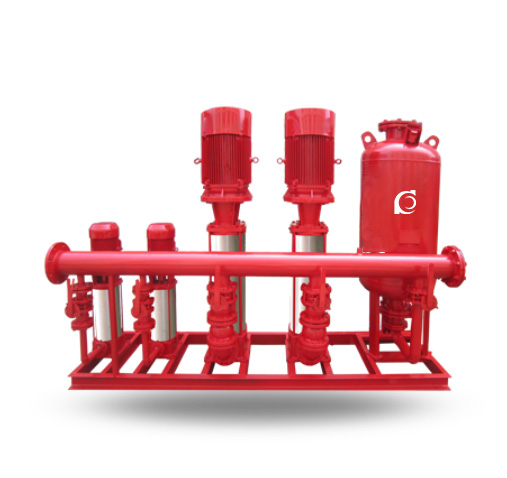
QHYX-GDL Automatic Sprinkler Booster Set is an integrated sprinkler pressure stabilization and boosting unit designed for automatic sprinkler pipeline networks.
It resolves standby pressure drop, minor leakage-induced pressure loss, and initial discharge pressure fluctuation without frequent activation of main fire pumps.
It is installed in high-rise buildings, commercial complexes, underground parking facilities, and industrial sprinkler systems requiring intelligent pressure maintenance.
Model Designation

Applications
- Wet automatic sprinkler systems in high-rise buildings
- Commercial mall sprinkler protection networks
- Underground parking sprinkler standby systems
- Industrial plant automatic sprinkler loops
- Fire pump rooms requiring intelligent pressure monitoring
Engineering Advantages
- Vertical multistage GDL booster pump ensures high-head compact boosting
- Intelligent control cabinet enables automatic pressure sensing and start-stop logic
- Pressure tank buffering reduces frequent cycling and stabilizes system pressure
- Skid-mounted integrated assembly simplifies installation and alignment
- Dual-pump duty/standby configuration improves operational reliability
System Components
QHYX-GDL Sprinkler Boosting System Components:
- GDL vertical multistage centrifugal pump (duty/standby)
- Pressure tank
- Intelligent fire control cabinet
- Pressure transmitter / pressure switch
- Check valves and isolation valves
- Integrated base frame and piping manifold
Technical Parameters
Service Conditions
Designed for automatic sprinkler system pressure maintenance and initial discharge boosting duty.
Operating Conditions
Flow rate: /h
Head: m
Power range: W
Speed: rpm
Liquid temperature: ≤
Working pressure: ≤
Detailed parameter tables are provided below.
Performance Parameters
| Applicable buildings |
Spray flow
(L/s) |
Sprinkler operating
pressure (MPa) |
Applicable building height
(m) |
Recommended packaged water supply model
Vertical pump set |
||
| Building type |
Design spray density
(L/min·m²) |
Coverage area
(m²) |
||||
| Industrial (production) building | 10 | 300 | 60 | 0.1 | ≤12 | QHYX60-0.24-100 XBD-GDL-3 |
| Industrial (production) building | 10 | 300 | 60 | 0.1 | ≤24 | QHYX60-0.4-100 XBD-GDL-3 |
| Industrial (production) building | 10 | 300 | 60 | 0.1 | ≤36 | QHYX60-0.6-100 XBD-GDL-3 |
| Industrial (production) building | 10 | 300 | 60 | 0.1 | ≤50 | QHYX60-0.8-100 XBD-GDL-3 |
| Industrial (production) building | 10 | 300 | 60 | 0.1 | ≤72 | QHYX60-1.0-100 XBD-GDL-3 |
| Industrial (production) building | 10 | 300 | 60 | 0.1 | ≤100 | QHYX60-1.2-100 XBD-GDL-3 |
| Storage building | 15 | 300 | 90 | 0.1 | ≤12 | QHYX90-0.24-150 XBD-GDL-3 |
| Storage building | 15 | 300 | 90 | 0.1 | ≤24 | QHYX90-0.4-150 XBD-GDL-3 |
| Storage building | 15 | 300 | 90 | 0.1 | ≤36 | QHYX90-0.6-150 XBD-GDL-3 |
| Storage building | 15 | 300 | 90 | 0.1 | ≤50 | QHYX90-0.8-150 XBD-GDL-3 |
| Storage building | 15 | 300 | 90 | 0.1 | ≤72 | QHYX90-1.0-150 XBD-GDL-3 |
| Storage building | 15 | 300 | 90 | 0.1 | ≤100 | QHYX90-1.2-150 XBD-GDL-3 |
| Ordinary hazard | 6 | 300 | 40 | 0.1 | ≤12 | QHYX40-0.24-100 XBD-GDL-3 |
| Ordinary hazard | 6 | 300 | 40 | 0.1 | ≤24 | QHYX40-0.4-100 XBD-GDL-3 |
| Ordinary hazard | 6 | 300 | 40 | 0.1 | ≤36 | QHYX40-0.6-100 XBD-GDL-3 |
| Ordinary hazard | 6 | 300 | 40 | 0.1 | ≤50 | QHYX40-0.8-100 XBD-GDL-3 |
| Ordinary hazard | 6 | 300 | 40 | 0.1 | ≤72 | QHYX40-1.0-100 XBD-GDL-3 |
| Ordinary hazard | 6 | 300 | 40 | 0.1 | ≤100 | QHYX40-1.2-100 XBD-GDL-3 |
| Light hazard | 3 | 300 | 15 | 0.1 | ≤12 | QHYX15-0.24-65 XBD-GDL-3 |
| Light hazard | 3 | 300 | 15 | 0.1 | ≤24 | QHYX15-0.4-65 XBD-GDL-3 |
| Light hazard | 3 | 300 | 15 | 0.1 | ≤36 | QHYX15-0.6-65 XBD-GDL-3 |
| Light hazard | 3 | 300 | 15 | 0.1 | ≤50 | QHYX15-0.8-65 XBD-GDL-3 |
| Light hazard | 3 | 300 | 15 | 0.1 | ≤72 | QHYX15-1.0-65 XBD-GDL-3 |
| Light hazard | 3 | 300 | 15 | 0.1 | ≤100 | QHYX15-1.2-65 XBD-GDL-3 |
| Users can select suitable models according to the parameters provided above. | ||||||
How to Select a Pump Model
- Determine sprinkler system design pressure and minimum required residual pressure
- Calculate initial sprinkler discharge flow rate
- Select appropriate pressure tank volume for buffering stability
- Confirm dual-pump configuration requirement
- Verify system maximum working pressure does not exceed 1.6 MPa
Engineering Notes
- Booster set should be installed downstream of main fire pump discharge header
- Pressure tank pre-charge pressure must align with system static pressure
- Control logic must coordinate with fire alarm interlock system
- Oversized booster pumps may cause pressure oscillation
Compliance & Quality Assurance
- Factory hydraulic performance testing of GDL pumps
- Pressure tank hydrostatic pressure test
- Electrical cabinet functional verification
- Insulation resistance and grounding inspection
- Optional third-party inspection available
Safety Notice
- Do not operate under dry-running condition
- Ensure correct pressure setting before commissioning
- Disconnect power before maintenance
- Do not exceed rated working pressure
OEM & Customization
This pump series supports engineered configuration and duty-based matching. Technical adjustments can be made according to system requirements and installation conditions.
Available options include:
• Motor voltage & frequency
• Pressure tank capacity selection
• Control cabinet configuration
• Wetted parts material selection
• Surface coating and corrosion protection
Configuration is determined based on duty point and project specifications.
FAQs
Q: Can the booster set operate under VFD control?
A: Yes, VFD integration is available for precise pressure regulation.
Q: What is the maximum allowable working pressure?
A: The maximum allowable working pressure is 1.6 MPa.
Q: Why is a pressure tank required in sprinkler systems?
A: It provides buffering capacity and prevents frequent cycling during minor leakage conditions.
Q: What pump type is used in this booster set?
A: Vertical multistage GDL centrifugal pumps are applied.
Q: Can this unit replace the main fire pump?
A: No, it is designed for pressure maintenance and initial discharge boosting only.
Q: What liquid temperature is allowable?
A: Maximum allowable liquid temperature is 80°C.
Q: Is dual-pump configuration mandatory?
A: Dual duty/standby configuration is recommended for reliability but may vary by project design.