Product Overview
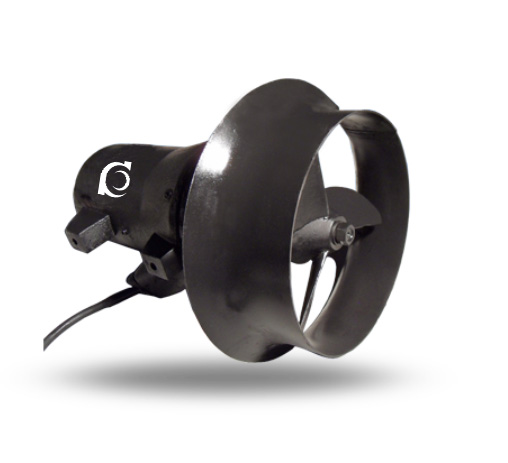
The QJB Submersible Centrifugal Aerator is a key device in wastewater treatment, used to achieve uniform mixing and circulation of solid-liquid biphasic flow or solid-liquid-gas flow during biological treatment processes. This device adopts a direct drive configuration and consists of a submersible motor, impeller, and installation system. Compared to traditional “gear reducer + high-power motor” agitators, it features a more compact structure, lower energy consumption, and easier maintenance. The impeller, made with precise projection or pressurized forming, offers high dimensional accuracy, high thrust, and a smooth profile, ensuring both efficiency and enhanced appearance. This series is specifically designed for applications requiring enhanced solid-liquid mixing and homogenization.
Model Designation
 Key Features
-
High-Precision Impeller: Precisely projected or stamped impeller with high manufacturing accuracy.
-
High Thrust Performance: Equipped with streamlined hydraulic performance for efficient thrust generation.
-
Compact Direct-Drive Structure: Reduces energy consumption and offers higher maintainability.
-
Easy Maintenance: The design is simpler and easier to maintain compared to traditional gear reducer-driven alternatives.
-
Optimized for Mixing: Designed to optimize solid-liquid mixing and homogenization tasks.
Engineering Overview
The QJB Aerator generates thrust and a controllable circulation field through a direct-drive impeller to achieve overall circulation and uniform mixing within the specified tank volume. Compared to traditional gear reducer-driven solutions, the compact direct-drive layout achieves the same mixing objectives while improving energy efficiency and maintainability. Selection and performance evaluation are typically based on the required design flow velocity in the tank.
Typical Applications
The QJB Submersible Aerator is widely used in:
-
Wastewater Treatment: Suitable for municipal and industrial wastewater treatment processes, for mixing, stirring, and circulating.
-
Landscape Water Bodies: Used in circulating and maintaining water quality in landscape water bodies. The induced water flow improves water quality, increases dissolved oxygen, and effectively prevents suspended solids from settling.
-
Chemical Processing: Employed in chemical processes for solid-liquid mixing and aeration.
For typical wastewater treatment processes, the recommended flow velocity range is 0.15–0.30 meters per second. Below 0.15 m/s, propulsion and mixing capabilities are insufficient; above 0.30 m/s, the process performance may be compromised and energy could be wasted.
System Configuration
The QJB Submersible Centrifugal Aerator system consists of the following main components:
-
Submersible Motor
-
Impeller
-
Installation System
-
Direct-Drive Configuration
Components and Supply
-
Motor: High-efficiency submersible motor, ensuring continuous operation of the aerator.
-
Impeller: Precisely designed impeller for efficient gas-liquid mixing.
-
Installation System: Easy to install and position, ensuring stable and secure installation.
-
Direct-Drive System: Reduces mechanical transmission components, lowering energy consumption and improving reliability.
Technical Service
-
24/7 customer service and technical support available.
-
Regular maintenance and inspection services to ensure the equipment operates at its best.
-
Customized solutions based on customer needs, optimizing system configuration and performance.
Operating Conditions
-
Operating Temperature: Suitable for ambient temperatures from 0°C to 50°C.
-
Operating pH Range: Suitable for pH ranges from 5 to 9.
-
Medium Density: ≤1150 kg/m³.
-
Sublimation Depth: ≤10 meters.
Important Note: The QJB Submersible Aerator must be fully submerged during operation. It should not be used in flammable, explosive, highly corrosive, or high-temperature environments. Custom designs for special operating conditions can be provided upon request.
Service Conditions
-
Regularly inspect the sealing performance to ensure no leakage.
-
Check and tighten all fasteners to ensure stability and safety.
-
Ensure the aerator does not operate in a dry condition to prevent damage.
Protection Features
-
Overload Protection: Prevents pump damage during overload operation.
-
Temperature Control Protection: The motor automatically stops if the temperature exceeds preset limits.
-
Low Liquid Level Protection: Automatically detects liquid levels to prevent dry running.
Selection Criteria
When selecting the QJB Submersible Centrifugal Aerator, the following factors should be considered:
-
Medium Type: Select a pump suitable for the characteristics of the conveyed medium.
-
Installation Environment: Choose a model suitable for the available installation space and environmental conditions.
-
Flow and Head Requirements: Choose the appropriate flow and head based on system requirements.
-
Energy Efficiency: Opt for energy-efficient equipment to reduce operational costs.
Specifications & Installation
Outline Drawing

Performance Parameters
| QJB Submersible Mixer — performance data at rated voltage 380 V and frequency 50 Hz are shown in the table below: | ||||||
| Model | Motor Power | Rated Current | Impeller Speed | Impeller Diameter | Thrust | Weight |
| kW | A | r/min | mm | N | kg | |
| QJB0.85/8-260/3-740/S | 0.85 | 3.2 | 740 | 260 | 163 | 55/65 |
| QJB1.5/6-260/3-980/S | 1.5 | 4 | 980 | 260 | 290 | 55/65 |
| QJB2.2/8-320/3-740/S | 2.2 | 5.9 | 740 | 320 | 582 | 88/93 |
| QJB4/6-320/3-960/S | 4 | 10.3 | 960 | 320 | 609 | 88/93 |
| QJB1.5/8-400/3-740/S | 1.5 | 5.2 | 740 | 400 | 600 | 74/82 |
| QJB2.5/8-400/3-740/S | 2.5 | 7 | 740 | 400 | 800 | 74/82 |
| QJB3/8-400/3-740/S | 3 | 8.6 | 740 | 400 | 920 | 74/82 |
| QJB4/6-400/3-980/S | 4 | 10.3 | 980 | 400 | 1200 | 74/82 |
| QJB4/12-620/3-480/S | 4 | 14 | 480 | 620 | 1400 | 190/206 |
| QJB5/12-620/3-480/S | 5 | 18.2 | 480 | 620 | 1800 | 196/212 |
| QJB7.5/12-620/3-480/S | 7.5 | 28 | 480 | 620 | 2600 | 240/256 |
| QJB10/12-620/3-480/S | 10 | 32 | 480 | 620 | 3300 | 250/266 |
| Note: 1) In the above mixing series, the values shown in the “Weight” column include the guide shroud. 2) Motor winding insulation class: F; protection class: IP68; motor duty type: S1 (continuous 24-hour operation). |
||||||
OEM & Custom
Chaodun Pump offers OEM and ODM customization for QJB series mixers, including material upgrades (stainless steel, duplex steel), explosion-proof motors, and adjustable mounting systems. Export-ready packaging, voltage customization, and private label branding are available upon request.
FAQs
- 1. What is the QJB submersible mixer used for?
It is used for mixing and circulation in wastewater, sludge, and aeration tanks. - 2. Can it be used continuously?
Yes, it is designed for 24-hour continuous submerged operation. - 3. What materials are available?
Standard models use cast iron; stainless-steel versions can be customized. - 4. What is the suitable flow speed?
The mixing velocity should be maintained between 0.15–0.3 m/s. - 5. Can it operate in corrosive environments?
Yes, with optional corrosion-resistant coatings or stainless materials. - 6. Is installation complicated?
No, the mixer can be mounted with a guide rail system for quick maintenance. - 7. DoesChaodun Pump support OEM export?
Yes, full OEM customization and export packaging are supported.