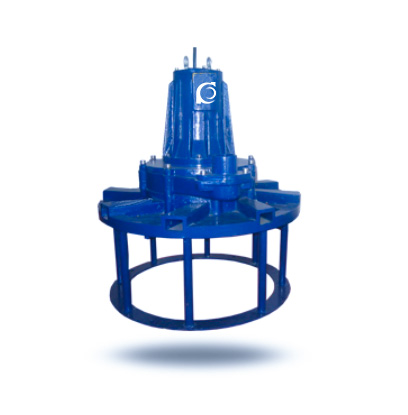
Product Overview
QXB Submersible Centrifugal Aerator is a submersible centrifugal aeration pump integrating hydraulic jet mixing and air suction for wastewater oxygenation and circulation.
It resolves insufficient dissolved oxygen, sludge deposition and poor mixing conditions in wastewater tanks without requiring external blowers or complex piping systems.
It is suitable for municipal sewage tanks, oxidation ditches, biochemical reactors and industrial wastewater treatment basins requiring continuous aeration and mixing.
Model Designation

Applications
- Oxidation ditch aeration and circulation in municipal WWTP
- Equalization tank oxygenation and sludge suspension
- Biochemical reaction basin DO enhancement
- Industrial wastewater mixing and aeration
- Aquaculture oxygen supplementation
Engineering Advantages
- Submersible centrifugal impeller creates negative pressure for automatic air intake, forming fine bubble dispersion for enhanced oxygen transfer efficiency.
- Integrated hydraulic mixing eliminates dead zones and prevents sludge sedimentation.
- Compact submerged motor design reduces surface noise and eliminates external air piping.
- Corrosion-resistant wetted components ensure durability in sewage environments.
System Components
QXB Submersible Centrifugal Aerator mainly consists of:
- Submersible motor
- Centrifugal impeller
- Air inlet pipe
- Mixing chamber
- Mechanical seal system
- Motor housing
Technical Specifications
Service Conditions
Suitable for municipal and industrial wastewater aeration under continuous submerged operation.
Operating Conditions
- Flow Rate: 10 – 250 m³/h (water circulation capacity)
- Head: 3 – 15 m (hydraulic head range)
- Power Range: 0.75 – 55 kW
- Speed: 1390 – 1480 rpm
- Liquid Temperature: ≤ 40°C
- Working Pressure: ≤ 0.6 MPa
Detailed parameter tables are provided below.
Specifications & Installation
Outline Drawing

Performance Parameters
| Model | Power (kW) | Rated Current (A) | Impeller Speed (r/min) | Effective Range Φ (m) | Submergence Depth (m) | Air Inlet Pipe Diameter (mm) | Air Intake (m³/h) | Weight (kg) |
| QXB0.75-32 | 0.75 | 2 | 1390 | 2.8 | 1–2 | 32 | 15–10 | 62 |
| QXB1.5-32 | 1.5 | 3.7 | 1400 | 3.5 | 1–3 | 32 | 25–18 | 105 |
| QXB2.2-50 | 2.2 | 5.2 | 1430 | 4.8 | 1–3.5 | 50 | 44–25 | 182 |
| QXB3-50 | 3 | 6.8 | 1430 | 5.5 | 2–4 | 50 | 50–40 | 198 |
| QXB4-50 | 4 | 8.8 | 1440 | 6.5 | 2–4 | 50 | 75–45 | 234 |
| QXB5.5-65 | 5.5 | 11.8 | 1440 | 8.0 | 2–4.5 | 65 | 120–70 | 298 |
| QXB7.5-80 | 7.5 | 15.6 | 1440 | 10 | 2–4.6 | 80 | 160–75 | 318 |
| QXB11-80 | 11 | 22.3 | 1460 | 11 | 2–4.8 | 80 | 260–120 | 382 |
| QXB15-100 | 15 | 30.1 | 1460 | 12 | 2–5 | 100 | 325–220 | 413 |
| QXB18.5-100 | 18.5 | 36.5 | 1470 | 12.5 | 2–5 | 100 | 375–260 | 476 |
| QXB22-100 | 22 | 43.2 | 1470 | 13.5 | 2–5.5 | 100 | 470–260 | 495 |
| QXB30-150 | 30 | 56.8 | 1470 | 16 | 2–6 | 150 | 510–300 | 1200 |
| QXB37-150 | 37 | 69.8 | 1480 | 16 | 2–6 | 150 | 570–390 | 1296 |
| QXB45-150 | 45 | 84.2 | 1480 | 16 | 2–6 | 150 | 630–460 | 1380 |
| QXB55-150 | 55 | 103 | 1480 | 16 | 2–6 | 150 | 825–620 | 1430 |
How to Select a Pump Model
- Determine required dissolved oxygen level and basin volume
- Evaluate water depth and submergence conditions
- Confirm required mixing intensity and sludge suspension needs
- Select motor power based on continuous or intermittent duty
Engineering Notes
- Submerged installation reduces structural vibration transmission
- Fine bubble formation depends on rotational speed and intake design
- DO efficiency varies with water depth and temperature
- Continuous operation improves sludge activation stability
Compliance & Quality Assurance
- Hydraulic performance testing per model before shipment
- Insulation resistance and motor winding test
- Mechanical seal leakage test
- Material inspection for corrosion resistance
Safety Notice
- Do not operate under dry-running condition
- Ensure full submergence before startup
- Disconnect power before maintenance
- Avoid operation beyond rated voltage range
OEM & Custom
This pump series supports engineered configuration and duty-based matching. Technical adjustments can be made according to system requirements and installation conditions.
Available options include:
• Motor voltage & frequency
• Mechanical seal type and configuration
• Wetted parts material selection
• Surface coating and corrosion protection
Configuration is determined based on duty point and project specifications.
Based on duty point and project specifications.
FAQs
Q: Can the aerator operate under VFD control?
A: Yes, variable frequency control can adjust mixing intensity and oxygen transfer rate.
Q: What is the allowable submergence depth?
A: It depends on motor insulation class and sealing configuration; refer to model specifications.
Q: What sealing system is used?
A: Double mechanical seal in oil chamber configuration is typically applied.
Q: Can it handle solids in wastewater?
A: It is suitable for standard sewage solids within specified particle limits.
Q: How is oxygen transfer efficiency determined?
A: It depends on impeller speed, bubble size distribution and basin depth.
Q: Is continuous operation supported?
A: Yes, the unit is designed for continuous submerged duty.