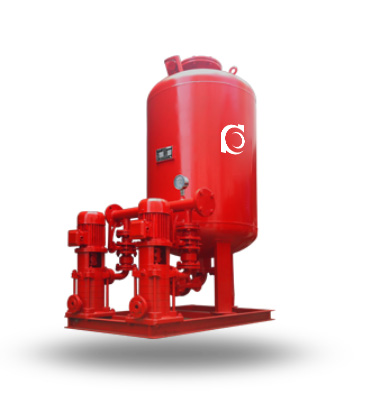
Product Overview
The W/W/-HY Fire Pressure Stabilizing Booster is a specialized pressure boosting and stabilization system designed for firefighting water supply applications, built in strict compliance with GB 6245-2006 and NFPA 20 standards. It is designed to address the issue of insufficient static pressure at the most unfavorable point in temporary high-pressure firefighting water supply systems, particularly when the elevated firefighting water tank cannot meet the required pressure.
Model Designation

Key Features
- The W/W/-HY Fire Pressure Stabilizing Booster uses high-efficiency and stable pumps to provide continuous water flow and pressure for the system.
- The unit adopts a modular design for easy installation and maintenance, ensuring the system operates efficiently and stably.
- Pneumatic pumps provide stable pressure output, suitable for low-maintenance and high-efficiency applications.
Engineering Summary
The unit uses coordinated pressure boosting and stabilization to maintain system pressure and compensate for normal pipeline leakage. With an integrated diaphragm pressure tank and a pressure stabilizing pump, the system operates automatically under electrical control, providing an effective auxiliary pressure stabilizing device in firefighting systems.
Applications
This system is mainly used in multi-story and high-rise buildings for:
-
Fire hydrant water supply systems
-
Wet automatic sprinkler systems
It is also suitable for other firefighting water supply systems and selected domestic pressure stabilization applications.
System Configuration
-
SQL Diaphragm Pressure Tank: For continuous pressure maintenance.
-
Fire Pressure Stabilizing Pump: Works with the pressure tank to ensure stable operation.
-
Electrical Control Cabinet: Integrated control and monitoring system for automatic operation.
-
Measurement and Monitoring Instruments: For real-time monitoring of pressure and water flow to ensure system stability.
-
Related Pipes and Connectors: Including all necessary connections and installation accessories.
System Components
-
Diaphragm Pressure Tank: Stores and regulates water pressure to ensure continuous supply.
-
Pressure Stabilizing Pump: Maintains system pressure to prevent fluctuations.
-
Electrical Control System: Responsible for automatic start/stop and real-time monitoring.
Design Fundamentals
The system adopts an integrated packaging configuration, with the pressure stabilizing pump directly coupled to the diaphragm pressure tank. The modular layout facilitates on-site installation and integration. The system operates automatically through preset pressure logic, ensuring efficient and stable firefighting water supply.
Selection and Operational Principles
-
Selection Principles: Choose the appropriate pump type and supporting equipment based on the system’s design flow rate and required pressure.
-
Operational Principles: Ensure efficient operation and reliable emergency response, with regular checks and maintenance to ensure long-term stability.
Demand Applications
Suitable for firefighting systems that require stable water pressure and continuous water supply, particularly during power outages, providing a reliable backup water source.
Intermittent Applications
Suitable for applications that require intermittent pressurization, such as temporary firefighting water supply systems during off-peak hours.
Operational Principles
The system ensures stable operation and automatically adjusts based on pressure changes to meet firefighting needs while maintaining long-term stable operation.
Technical Service
-
Flow Range: 10–800 L/s
-
Pressure Range: 0.2–2.2 MPa
-
Rated Speed: 1500 / 1800 / 2400 rpm
-
Ambient Temperature: –15°C to +55°C
-
Atmospheric Pressure: ≥90 kPa
Technical Specifications
-
Rated Working Pressure of SQL Diaphragm Pressure Tank: 0.6 MPa / 1.0 MPa / 1.6 MPa
-
Effective Fire Water Storage Capacity of SQL Diaphragm Tank: ≥150L / 300L / 450L
-
Effective Pressure Stabilizing Water Volume: ≥50L
-
Pressure Difference for Buffer Water Volume: 0.02–0.03 MPa
-
Pressure Difference for Stabilizing Water Volume: 0.05–0.06 MPa
-
Operating Temperature Range: 0.6°C to 40°C
Service Conditions
-
Ambient Temperature: 5°C to 40°C
-
Water Source Requirements: Suitable for high-position water tanks or bottom-level water pools.
Environmental Requirements
The equipment operates stably under normal temperature and humidity conditions, suitable for most environments.
Electric Control Functions
The equipment is equipped with both automatic and manual control functions, and can be integrated with the firefighting control center to ensure rapid system activation during emergencies.
Operating Instructions
The operating system is user-friendly, with detailed operation and maintenance manuals to ensure the equipment runs efficiently and remains stable.
Installation & Dimensions
Installation Diagram
 Performance Data
|
|
|
Performance Parameters
| Item No. | Pressure Booster Model | Firefighting Pressure MPa P1 | Vertical Diaphragm Air Tank | Matching Pump | “Operating Weight (kg)” | Operating Pressure (MPa) | “Pressure Stabilizing Water Volume (L)” | ||||
| Model Specifications | Working Pressure Ratio | Firefighting Water Capacity (L) | Model | ||||||||
| Rated Capacity | Actual Volume | ||||||||||
| 1 | ZW(L)-I-X-7 | 0.1 | SQL800*0.6 | 0.60 | 300 | 319 | 25LG3-10*4 1.5KW | 1452 |
P1=0.10 Ps1=0.26
P2=0.23 Ps2=0.31 |
54 | |
| 2 | ZW(L)-I-Z-10 | 0.16 | SQL800*0.6 | 0.80 | 150 | 159 | 25LG3-10*4 1.5KW | 1428 |
P1=0.16 Ps1=0.26
P2=0.23 Ps2=0.31 |
70 | |
| 3 | ZW(L)-I-X-10 | 0.16 | SQL800*0.6 | 0.60 | 300 | 319 | 25LG3-10*5 1.5KW | 1474 |
P1=0.16 Ps1=0.36
P2=0.33 Ps2=0.42 |
52 | |
| 4 | ZW(L)-I-X-13 | 0.22 | SQL1000*0.6 | 0.76 | 300 | 329 | 25LG3-10*4 1.5KW | 2312 |
P1=0.22 Ps1=0.35
P2=0.32 Ps2=0.40 |
97 | |
| 5 | ZW(L)-XZ-10 | 0.16 | SQL1000*0.6 | 0.65 | 450 | 480 | 25LG3-10*4 1.5KW | 2312 |
P1=0.16 Ps1=0.33
P2=0.30 Ps2=0.38 |
86 | |
| 6 | ZW(L)-XZ-13 | 0.22 | SQL1000*0.6 | 0.67 | 450 | 452 | 25LG3-10*5 1.5KW | 2312 |
P1=0.22 Ps1=0.41
P2=0.38 Ps2=0.46 |
80 | |
| 7 | ZW(L)-II-Z- | A | 0.22-0.38 | SQL800*0.6 | 0.80 | 150 | 159 | 25LG3-10*6 2.2KW | 1452 |
P1=0.38 Ps1=0.53
P2=0.50 Ps2=0.60 |
61 |
| 8 | ZW(L)-II-Z- | B | 0.38-0.50 | SQL800*1.0 | 0.80 | 150 | 159 | 25LG3-10*8 2.2KW | 1513 |
P1=0.50 Ps1=0.68
P2=0.65 Ps2=0.75 |
51 |
| 9 | ZW(L)-II-Z- | C | 0.50-0.65 | SQL1000*1.6 | 0.85 | 150 | 206 | 25LG3-10*9 2.2KW | 1653 |
P1=0.65 Ps1=0.81
P2=0.78 Ps2=0.86 |
59 |
| 10 | ZW(L)-II-Z- | D | 0.65-0.85 | SQL1000*1.6 | 0.85 | 150 | 206 | 25LG3-10*11 3KW | 1701 |
P1=0.85 Ps1=1.04
P2=1.02 Ps2=1.10 |
57 |
| 11 | ZW(L)-II-Z- | E | 0.85-1.00 | SQL1000*1.6 | 0.85 | 150 | 206 | 25LG3-10*13 4KW | 1709 |
P1=1.00 Ps1=1.21
P2=1.19 Ps2=1.27 |
50 |
| Item No. | Pressure Booster Model | Firefighting Pressure MPa P1 | Vertical Diaphragm Air Tank | Matching Pump | “Operating Weight (kg)” | Operating Pressure (MPa) | “Pressure Stabilizing Water Volume (L)” | ||||
| Model Specifications | Working Pressure Ratio | Firefighting Water Capacity (L) | Model | ||||||||
| Rated Capacity | Actual Volume | ||||||||||
| 12 | ZW(L)-II-X- | A | 0.22-0.38 | SQL1000*0.6 | 0.78 | 300 | 302 | 25LG3-10*6 2.2KW | 2344 |
P1=0.38 Ps1=0.55
P2=0.52 Ps2=0.60 |
72 |
| 13 | ZW(L)-II-X- | B | 0.38-0.50 | SQL1000*1.0 | 0.78 | 300 | 302 | 25LG3-10*8 2.2KW | 2494 |
P1=0.50 Ps1=0.70
P2=0.67 Ps2=0.75 |
61 |
| 14 | ZW(L)-II-X- | C | 0.50-0.65 | SQL1000*1.6 | 0.78 | 300 | 302 | 25LG3-10*10 3KW | 2689 |
P1=0.65 Ps1=0.88
P2=0.86 Ps2=0.93 |
51 |
| 15 | ZW(L)-II-X- | D | 0.65-0.85 | SQL1000*1.6 | 0.85 | 300 | 355 | 25LG3-10*13 4KW | 2703 |
P1=0.85 Ps1=1.05
P2=1.02 Ps2=1.10 |
82 |
| 16 | ZW(L)-II-X- | E | 0.85-1.00 | SQL1000*1.6 | 0.88 | 300 | 355 | 25LG3-10*15 4KW | 2730 |
P1=1.00 Ps1=1.21
P2=1.19 Ps2=1.26 |
73 |
| 17 | ZW(L)-II-XZ- | A | 0.22-0.38 | SQL1200*0.6 | 0.80 | 450 | 474 | 25LG3-10*6 2.2KW | 3641 |
P1=0.38 Ps1=0.53
P2=0.50 Ps2=0.58 |
133 |
| 18 | ZW(L)-II-XZ- | B | 0.38-0.50 | SQL1200*1.0 | 0.80 | 450 | 474 | 25LG3-10*8 2.2KW | 3947 |
P1=0.50 Ps1=0.68
P2=0.65 Ps2=0.73 |
110 |
| 19 | ZW(L)-II-XZ- | C | 0.50-0.65 | SQL1200*1.6 | 0.80 | 450 | 474 | 25LG3-10*10 3KW | 3961 |
P1=0.65 Ps1=0.87
P2=0.84 Ps2=0.92 |
90 |
| 20 | ZW(L)-II-XZ- | D | 0.65-0.85 | SQL1200*1.6 | 0.80 | 450 | 474 | 25LG3-10*12 4KW | 4124 |
P1=0.85 Ps1=1.12
P2=1.09 Ps2=1.17 |
73 |
| 21 | ZW(L)-II-XZ- | E | 0.85-1.00 | SQL1200*1.6 | 0.80 | 450 | 474 | 25LG3-10*14 4KW | 4156 |
P1=1.00 Ps1=1.30
P2=1.27 Ps2=1.35 |
64 |
|
Notes:
|
|||||||||||
Operating Manual
I. Product Overview
This booster and pressure stabilization equipment is developed and designed based on the Ministry of Construction’s “Document [1996] 108” from August 1996, and complies with the specifications of 98S205 (formerly 98S176).
The equipment is specifically designed to address situations where the height of the elevated fire water tank in temporary high-pressure fire water systems does not meet the required conditions. It is a dedicated booster and pressure stabilization system for firefighting (hereinafter referred to as “the equipment”).
This equipment is suitable for fire hydrant water supply systems and wet automatic sprinkler systems in multi-story and high-rise building projects, as well as various fire-fighting and domestic water supply systems.
II. Equipment and Principle
The equipment consists of an SQL air pressure water tank, an XBD-GDL multi-stage fire hydrant pump, an electrical control box, instruments, pipeline accessories, and other components.
The design follows the technical standards of “Fire Protection Design Specification for Civil Buildings” GB50045-95 and the “Pressure Water Supply Design Specification” CECS76:95.
The working principle of the equipment is to control the water pump operation based on the set operating pressures P1, P2, Ps1, and Ps2, thereby achieving the functions of boosting and stabilizing pressure.
III.Pressure Control
The required fire-fighting pressure at the disadvantage point, P1, is calculated and set as the air pressure in the water tank, which is then used to calculate P2. The control of the steady pressure water pump’s operation is achieved by setting Ps1 and Ps2.
The calculation of the fire-fighting pressure P1 varies depending on different scenarios (such as the fire hydrant system or automatic sprinkler system) and includes factors such as pipeline pressure losses, local losses, and the pressure required at the water gun nozzle.
IV. Functions & Electrical Control
The equipment must ensure that the fire-fighting water supply system’s disadvantage point pressure remains at the required value, while ensuring that the air pressure water tank always holds enough fire-fighting water.
The electrical control system offers both automatic and manual functions, and it is connected to the fire control center or fire pump room, supporting alternating operation of two pressure stabilization pumps.
The electrical control system also features a maintenance mode, allowing the pump to switch to a backup pump in the event of a malfunction, ensuring the continuous operation of the equipment.
OEM & Custom
Chaodun Pump provides OEM & ODM customization for W-HY fire pressure stabilizing systems, including control cabinet design, tank capacity, and pump selection. Our equipment supports hydrant and sprinkler combined configurations, tested under GB50045-95 and CECS76:95 standards for superior performance and reliability.
FAQs
- Q1: What is the W-HY Fire Pressure Boosting & Stabilizing Equipment used for?
It maintains steady firefighting pressure in hydrant and sprinkler systems for buildings and industrial facilities. - Q2: Can I customize the equipment design?
Yes, Chaodun Pump offers OEM/ODM customization for pressure range, control panel, and pump configuration. - Q3: What are the main components?
The system includes a diaphragm air tank, booster pump, control cabinet, and monitoring instruments. - Q4: What’s the difference between I-type and II-type installation?
I-type is installed near high-level water tanks, II-type near fire pump rooms or reservoirs. - Q5: Does it meet international standards?
Yes, it conforms to GB50045-95 and CECS76:95 fire design codes. - Q6: Is the system suitable for both hydrant and sprinkler use?
Yes, combined models (XZ) support both systems simultaneously. - Q7: Can Chaodun Pump provide certificates for export?
Yes, all exported units include compliance certificates, inspection reports, and technical documentation.