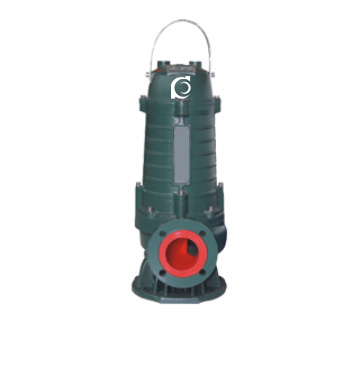
Product Overview
The WQK/QG Non-Blocking Submersible Sewage Pump is a cutting-type wastewater pump designed for media containing high solids and fibers. It integrates the functions of cutting, shredding, and pumping into a single unit, capable of cutting and destroying long fibers, plastics, paper, belts, straws, ropes, and similar debris before discharging, significantly enhancing its anti-clogging performance and system reliability.
The pump features an optimized hydraulic design to ensure stable operation across the entire head range. The dry submersible motor is precisely matched with the hydraulic pump section, making this series ideal for applications requiring continuous duty, strong anti-clogging capability, and reliable sewage discharge performance.
Model Designation

Key Features
-
Powerful Anti-Clogging Capability: Integrates cutting, shredding, and pumping functions, effectively handling long fibers, plastics, paper, belts, straws, ropes, and other debris.
-
Stable Flow with Low Pulsation: Provides continuous and stable flow without pulsation, agitation, or leakage, ensuring smooth operation.
-
High Self-Priming Ability: Excellent self-priming capabilities, making it ideal for systems requiring forward and reverse flushing of pipelines.
-
Low Vibration and Noise: Operates with low vibration and low noise, ensuring smooth and quiet operation even under continuous use.
-
Easy Maintenance: Simple structure, easy to disassemble, inspect, and maintain, reducing downtime and maintenance costs.
Engineering Overview
The WQK/QG Non-Blocking Submersible Sewage Pump features a reinforced structure, suitable for harsh engineering applications. The high-efficiency cutting system effectively reduces the risk of pipeline blockages caused by fibers and solid contaminants. The shaft system is made of hard alloy materials and is equipped with double mechanical seals and oil chamber sealing rings, enhancing abrasion resistance and sealing performance. The pump is suitable for non-corrosive sewage with a medium temperature of up to 40°C, a density of up to 1200 kg/m3, and a pH range of 5-9. The maximum water lifting depth should not exceed half the height of the motor to ensure motor safety during long-term operation.
Typical Applications
The WQK/QG Non-Blocking Cutter Submersible Sewage Pump is widely used in:
-
Construction Sites, Foundation Engineering, Municipal Facilities, and Hydroelectric Projects: Sewage discharge in construction sites, municipal infrastructure, and water treatment facilities.
-
High-Rise Buildings, Civil Defense Projects, Subways, and Other Underground Facilities: Sewage discharge from basements, civil defense bunkers, and underground levels of buildings.
-
Small and Medium Enterprises’ Wastewater Treatment and Circulating Water Systems: Effective for treating wastewater and transporting circulating water in small and medium-sized industries.
-
Industrial Applications: Used in food processing, papermaking, brewing, iron and non-ferrous metallurgy, leather, textiles, pharmaceuticals, and cement industries for sewage transport.
-
Agricultural Applications: Used in poultry farms, pig farms, aquaculture facilities, fish pond drainage and cleaning, septic tanks, and similar wastewater treatment applications.
Note: The performance parameters of the WQK model are the same as those of the WQK/QG model, except that the cutting device is omitted. The internal structure remains unchanged.
System Configuration
The WQK/QG Non-Blocking Submersible Sewage Pump adopts a single-stage, single-suction cantilever design. The main components include the pump casing, impeller, pump cover, wear plate, and bearing bracket assembly. The pump has axial suction and radial (side) discharge. When viewed from the motor side, the pump shaft rotates clockwise. The pump features a back-pull design, allowing maintenance without removing the suction or discharge pipes, facilitating on-site repair.
Components and Supply
The WQK/QG series pump’s key components include the pump casing, impeller, wear plates, and bearing bracket assembly. The pump housing can be made from cast iron or stainless steel, and the gearbox and wet parts can be partially or completely made of stainless steel to meet various corrosion resistance and hygiene requirements. The wear-resistant materials used include wear-resistant rubber, food-grade rubber, and oil-resistant rubber.
Technical Service
The WQK/QG series pump provides comprehensive technical support, including installation, commissioning, regular maintenance, and troubleshooting, ensuring long-term, efficient, and reliable performance.
Operating Conditions
-
Pumped Liquid Temperature: ≤40°C
-
Medium Density: ≤1200 kg/m³
-
pH Range: 5–9
-
Self-Priming Capability: The pump is designed with strong self-priming capabilities, suitable for both forward and reverse operation, ideal for pipeline flushing or water replacement.
-
Power Source: Must be connected to a reliable power source to ensure normal operation.
Service Conditions
Regular inspection of the pump’s sealing system, impeller, wear plates, and bearing bracket assembly is recommended to ensure efficient and safe operation.
Protection Features
The WQK/QG series pump is equipped with multiple protection features, including overcurrent protection, temperature monitoring, and liquid level protection systems, ensuring the pump stops operating in abnormal conditions to prevent damage to the equipment.
Selection Standards
When selecting the pump model, consider factors such as the temperature of the media, pH value, solid particle size, and the required flow and head of the pump to ensure the selection of the most suitable configuration.
Performance Parameters
|
Model
|
Diameter
|
Maximum Flow Rate
|
Maximum Head |
Motor Power (kW)
|
Voltage
|
|
mm
|
m3/h
|
m
|
KW
|
v
|
|
|
WQK10-15-1.1
|
50
|
23
|
17
|
1.1
|
380
|
|
WQK15-9-1.1
|
65
|
30
|
15
|
1.1
|
380
|
|
WQK15-15-1.5
|
50
|
25
|
20
|
1.5
|
380
|
|
WQK20-12-1.5
|
65
|
35
|
18
|
1.5
|
380
|
|
WQK9-22-2.2
|
50
|
32
|
25
|
2.2
|
380
|
|
WQK25-12-2.2
|
65
|
45
|
21
|
2.2
|
380
|
|
WQK35-10-2.2
|
80
|
56
|
15
|
2.2
|
380
|
|
WQK15-25-3
|
50
|
35
|
30
|
3
|
380
|
|
WQK25-18-3
|
65
|
48
|
24
|
3
|
380
|
|
WQK35-13-3
|
80
|
60
|
18
|
3
|
380
|
|
WQK50-9-3
|
100
|
68
|
12
|
3
|
380
|
|
WQK15-32-4
|
50
|
40
|
36
|
4
|
380
|
|
WQK25-28-4
|
65
|
50
|
32
|
4
|
380
|
|
WQK40-18-4
|
80
|
65
|
27
|
4
|
380
|
|
WQK50-12-4
|
100
|
85
|
18
|
4
|
380
|
|
WQK18-34-5.5
|
50
|
43
|
40
|
5.5
|
380
|
|
WQK30-26-5.5
|
65
|
55
|
35
|
5.5
|
380
|
|
WQK40-24-5.5
|
80
|
70
|
30
|
5.5
|
380
|
|
WQK70-10-5.5
|
100
|
95
|
22
|
5.5
|
380
|
|
WQK100-7-5.5
|
150
|
120
|
12
|
5.5
|
380
|
|
WQK45-24-7.5
|
80
|
85
|
35
|
7.5
|
380
|
|
WQK70-18-7.5
|
100
|
110
|
30
|
7.5
|
380
|
|
WQK100-12-7.5
|
150
|
152
|
20
|
7.5
|
380
|
Operating Manual
1.Pre-Operation Check
Before using the pump, check the power cable for any damage. Avoid pulling or damaging the cable during handling and installation to prevent it from breaking and causing electric leakage. If the cable is cracked, replace it immediately. Use a megohmmeter to check the pump’s insulation resistance (the resistance must not be lower than 1 MΩ).
2.Grounding & Electrical Protection
Confirm that the grounding wire (usually yellow-green in color or marked with a grounding symbol) is correctly connected according to the prescribed procedure. (The grounding wire provided by the factory is marked with a grounding symbol).
Select the appropriate protective devices (such as leakage protectors, air switches, phase loss overcurrent protectors, etc.), and avoid connecting directly using knife switches.
3.Installation & Connection
Connect the power supply according to standards, and test the connection. Check if the pump operates normally and verify the rotation direction. If the rotation is incorrect, swap any two of the three power supply lines (the motor should not run for more than 30 seconds in reverse direction).
Install the discharge connection and hose (or metal pipe), tie a rope to the pump handle (do not use the cable as a substitute for a lifting rope), place the pump into the liquid to be pumped, and then connect the power supply to start operation.
4.Safety & Operation Guidelines
For safety, during the pump’s operation, it is strictly prohibited to perform underwater operations (e.g., moving, inspecting, or troubleshooting the pump) near the pump, as this could lead to an electric shock if leakage occurs.
The pump must not operate with the pump body exposed above the water surface for long periods (or even for short periods). Frequent on/off cycling should be avoided to prevent motor overheating and damage.
OEM & Custom
We provide OEM/ODM services for global clients, including stainless-steel versions, special voltages (220/415/460V), explosion-proof motors, extended cable lengths, and control panels. Custom pump configurations, branding, and packaging are available for export projects. All products are tested to ISO and CE standards for quality and reliability.
FAQs
- Q: What makes the WQK/QG pump different from regular sewage pumps?
A: It integrates a cutting mechanism that grinds long fibers, plastics, and paper into small pieces before discharge, preventing clogging in pipes. - Q: What materials are used for the cutter and impeller?
A: The cutting blades and impellers are made of stainless steel with high hardness and wear resistance for long service life. - Q: Can it handle high-viscosity or sand-containing wastewater?
A: Yes, but for heavy sand content, we recommend using our vortex-type sewage pumps to reduce wear. - Q: What kind of power supply is required?
A: Standard 380V three-phase, 50Hz. Other voltages and frequencies can be customized for export markets. - Q: How should the pump be installed and operated?
A: Use a safety rope to lower the pump; do not lift by the cable. Ensure proper grounding and avoid dry running or long-term operation above water. - Q: Is OEM labeling available?
A: Yes, we support private label, custom nameplates, and packaging for distributors and project buyers. - Q: Which markets are these pumps exported to?
A: Our WQK/QG grinder pumps are exported to Southeast Asia, the Middle East, Africa, and South America, widely used in municipal, industrial, and agricultural systems.