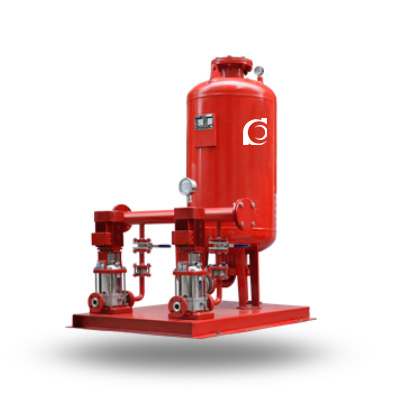
Product Overview
The ZW(L) Fire Pressure Boosting Water Supply System is a comprehensive firefighting pressure boosting and stabilization device designed according to the Ministry of Construction’s [1996] 108 document, in compliance with the 98S205 (formerly 98S176) standard. The system is designed to compensate for insufficient static pressure at the most unfavorable points in temporary high-pressure firefighting water supply systems, especially when high-level water tanks cannot withstand the required pressure. It provides reliable firefighting pressure boosting and stabilization, fully meeting firefighting requirements.
Model Designation

Key Features
- The ZW(L) Fire Pressure Boosting Water Supply System utilizes the XBD-GDL vertical multistage fire pump, ideal for high-pressure environments like high-rise buildings.
- The system features a modular design for easy installation and maintenance, ensuring reliable water supply when required.
- Pneumatic pumps deliver stable pressure output, effectively reducing the system’s energy consumption.
Engineering Summary
The ZW(L) Fire Pressure Boosting Water Supply System is mainly used for multi-story and high-rise buildings, fire hydrant systems, and wet automatic sprinkler systems. It can also be extended to other firefighting and domestic water supply applications. Through the coordinated operation of the diaphragm pressure tank and pressure stabilizing pump, the system maintains pipeline pressure under low flow conditions and compensates for normal pipeline leakage. When system pressure drops below the preset threshold, the pump automatically starts or stops based on control logic, ensuring stable and reliable firefighting pressure.
Applications
-
Fire Hydrant Systems: The water flow in fire hydrant systems ranges from 2.5 GPM to 5 GPM, meeting the requirements for different spray lengths.
-
Automatic Sprinkler Systems: Each sprinkler head has a flow rate of 1.0 GPM, ensuring effective fire suppression.
System Configuration
-
Diaphragm Pressure Tank
-
Pressure Stabilizing (Jockey) Pump
-
Electrical Control Cabinet
-
Monitoring and Control Instruments
-
Associated Pipelines and Accessories
System Components
The ZW(L) Fire Pressure Boosting Water Supply System includes a diaphragm pressure tank, pressure stabilizing pump, control cabinet, instruments, and associated pipelines and accessories, ensuring efficient and stable operation during installation and use.
Design Fundamentals
The design should be based on the required flow rate and water pressure, in combination with the characteristics of fire hydrant and sprinkler systems, ensuring system needs are met.
Selection and Operational Principles
-
Pressure and Flow Control
-
Pressure Control: The system controls the start and stop of the pressure tank by setting pressures P1, P2, Ps1, and Ps2, ensuring stable operation during the firefighting process.
-
Flow Requirements: The design should be based on the required firefighting flow during the initial stages of a fire, ensuring it meets the needs of various systems.
-
Demand Applications
-
Fire Hydrant Systems: The water flow in fire hydrant systems ranges from 2.5 GPM to 5 GPM, meeting the requirements for different spray lengths.
-
Automatic Sprinkler Systems: Each sprinkler head has a flow rate of 1.0 GPM, ensuring effective fire suppression.
Intermittent Applications
Suitable for applications that require intermittent pressurization, such as temporary firefighting water supply systems during off-peak hours.
Operational Principles
The system ensures stable operation and automatically adjusts based on pressure changes to meet firefighting needs while maintaining long-term stable operation.
Technical Specifications
Technical Specifications
-
Rated Working Pressure of SQL Diaphragm Pressure Tank: 0.6 MPa / 1.0 MPa / 1.6 MPa
-
Effective Fire Water Storage Capacity of SQL Diaphragm Tank: ≥150L / 300L / 450L
-
Effective Pressure Stabilizing Water Volume: ≥50L
-
Pressure Difference for Buffer Water Volume: 0.02–0.03 MPa
-
Pressure Difference for Stabilizing Water Volume: 0.05–0.06 MPa
-
Operating Temperature Range: 0.6°C to 40°C
Environmental Requirements
-
Ambient Temperature: 5°C to 40°C
-
Water Source Requirements: Suitable for high-position water tanks or bottom-level water pools.
Service Conditions
The equipment operates stably under normal temperature and humidity conditions, suitable for most environments
Electric Control Functions
The equipment is equipped with both automatic and manual control functions, and can be integrated with the firefighting control center to ensure rapid system activation during emergencies.
Operating Instructions
The operating system is user-friendly, with detailed operation and maintenance manuals to ensure the equipment runs efficiently and remains stable.
Installation & Dimensions
Installation Diagram

Performance Data
|
|
|
Performance Parameters
| No. |
Booster & Pressure-Stabilizing
Unit Model |
Fire Pressure P1
(MPa) |
Vertical Diaphragm Pressure Tank | Matched Pump |
Operating Weight
(kg) |
Operating Pressure
(MPa) |
Stabilizing Water Volume (L) | ||||
| Tank Model | Working Pressure Ratio | Fire Storage Water Volume (L) | Pump Model | ||||||||
| Rated Volume | Effective Volume | ||||||||||
| 1 | ZW(L)-I-X-7 | 0.1 | SQL800*0.6 | 0.60 | 300 | 319 | 25LG3-10*4 1.5KW | 1452 |
P1=0.10 Ps1=0.26
P2=0.23 Ps2=0.31 |
54 | |
| 2 | ZW(L)-I-Z-10 | 0.16 | SQL800*0.6 | 0.80 | 150 | 159 | 25LG3-10*4 1.5KW | 1428 |
P1=0.16 Ps1=0.26
P2=0.23 Ps2=0.31 |
70 | |
| 3 | ZW(L)-I-X-10 | 0.16 | SQL800*0.6 | 0.60 | 300 | 319 | 25LG3-10*5 1.5KW | 1474 |
P1=0.16 Ps1=0.36
P2=0.33 Ps2=0.42 |
52 | |
| 4 | ZW(L)-I-X-13 | 0.22 | SQL1000*0.6 | 0.76 | 300 | 329 | 25LG3-10*4 1.5KW | 2312 |
P1=0.22 Ps1=0.35
P2=0.32 Ps2=0.40 |
97 | |
| 5 | ZW(L)-XZ-10 | 0.16 | SQL1000*0.6 | 0.65 | 450 | 480 | 25LG3-10*4 1.5KW | 2312 |
P1=0.16 Ps1=0.33
P2=0.30 Ps2=0.38 |
86 | |
| 6 | ZW(L)-XZ-13 | 0.22 | SQL1000*0.6 | 0.67 | 450 | 452 | 25LG3-10*5 1.5KW | 2312 |
P1=0.22 Ps1=0.41
P2=0.38 Ps2=0.46 |
80 | |
| 7 | ZW(L)-II-Z- | A | 0.22-0.38 | SQL800*0.6 | 0.80 | 150 | 159 | 25LG3-10*6 2.2KW | 1452 |
P1=0.38 Ps1=0.53
P2=0.50 Ps2=0.60 |
61 |
| 8 | ZW(L)-II-Z- | B | 0.38-0.50 | SQL800*1.0 | 0.80 | 150 | 159 | 25LG3-10*8 2.2KW | 1513 |
P1=0.50 Ps1=0.68
P2=0.65 Ps2=0.75 |
51 |
| 9 | ZW(L)-II-Z- | C | 0.50-0.65 | SQL1000*1.6 | 0.85 | 150 | 206 | 25LG3-10*9 2.2KW | 1653 |
P1=0.65 Ps1=0.81
P2=0.78 Ps2=0.86 |
59 |
| 10 | ZW(L)-II-Z- | D | 0.65-0.85 | SQL1000*1.6 | 0.85 | 150 | 206 | 25LG3-10*11 3KW | 1701 |
P1=0.85 Ps1=1.04
P2=1.02 Ps2=1.10 |
57 |
| 11 | ZW(L)-II-Z- | E | 0.85-1.00 | SQL1000*1.6 | 0.85 | 150 | 206 | 25LG3-10*13 4KW | 1709 |
P1=1.00 Ps1=1.21
P2=1.19 Ps2=1.27 |
50 |
| No. |
Booster & Pressure-Stabilizing
Unit Model |
Fire Pressure P1
(MPa) |
Vertical Diaphragm Pressure Tank | Matched Pump |
Operating Weight
(kg) |
Operating Pressure
(MPa) |
Stabilizing Water Volume (L) | ||||
| Tank Model | Working Pressure Ratio | Fire Storage Water Volume (L) | Pump Model | ||||||||
| Rated Volume | Effective Volume | ||||||||||
| 12 | ZW(L)-II-X- | A | 0.22-0.38 | SQL1000*0.6 | 0.78 | 300 | 302 | 25LG3-10*6 2.2KW | 2344 |
P1=0.38 Ps1=0.55
P2=0.52 Ps2=0.60 |
72 |
| 13 | ZW(L)-II-X- | B | 0.38-0.50 | SQL1000*1.0 | 0.78 | 300 | 302 | 25LG3-10*8 2.2KW | 2494 |
P1=0.50 Ps1=0.70
P2=0.67 Ps2=0.75 |
61 |
| 14 | ZW(L)-II-X- | C | 0.50-0.65 | SQL1000*1.6 | 0.78 | 300 | 302 | 25LG3-10*10 3KW | 2689 |
P1=0.65 Ps1=0.88
P2=0.86 Ps2=0.93 |
51 |
| 15 | ZW(L)-II-X- | D | 0.65-0.85 | SQL1000*1.6 | 0.85 | 300 | 355 | 25LG3-10*13 4KW | 2703 |
P1=0.85 Ps1=1.05
P2=1.02 Ps2=1.10 |
82 |
| 16 | ZW(L)-II-X- | E | 0.85-1.00 | SQL1000*1.6 | 0.88 | 300 | 355 | 25LG3-10*15 4KW | 2730 |
P1=1.00 Ps1=1.21
P2=1.19 Ps2=1.26 |
73 |
| 17 | ZW(L)-II-XZ- | A | 0.22-0.38 | SQL1200*0.6 | 0.80 | 450 | 474 | 25LG3-10*6 2.2KW | 3641 |
P1=0.38 Ps1=0.53
P2=0.50 Ps2=0.58 |
133 |
| 18 | ZW(L)-II-XZ- | B | 0.38-0.50 | SQL1200*1.0 | 0.80 | 450 | 474 | 25LG3-10*8 2.2KW | 3947 |
P1=0.50 Ps1=0.68
P2=0.65 Ps2=0.73 |
110 |
| 19 | ZW(L)-II-XZ- | C | 0.50-0.65 | SQL1200*1.6 | 0.80 | 450 | 474 | 25LG3-10*10 3KW | 3961 |
P1=0.65 Ps1=0.87
P2=0.84 Ps2=0.92 |
90 |
| 20 | ZW(L)-II-XZ- | D | 0.65-0.85 | SQL1200*1.6 | 0.80 | 450 | 474 | 25LG3-10*12 4KW | 4124 |
P1=0.85 Ps1=1.12
P2=1.09 Ps2=1.17 |
73 |
| 21 | ZW(L)-II-XZ- | E | 0.85-1.00 | SQL1200*1.6 | 0.80 | 450 | 474 | 25LG3-10*14 4KW | 4156 |
P1=1.00 Ps1=1.30
P2=1.27 Ps2=1.35 |
64 |
| Note: 1. Symbols for operating pressure in the table: P1 — Charging pressure of the pressure tank (required fire pressure) (MPa) P2 — Start pressure of the fire pump (MPa) Ps1 — Start pressure of the booster / pressure-stabilizing pump (MPa) Ps2 — Stop pressure of the booster / pressure-stabilizing pump (MPa) 2. Items No. 1–6 are Type I units, generally installed in the high-level water tank room (with the most unfavorable hydrant located below the “unit”). 3. Items No. 7–21 are Type II units, usually installed in the fire pump room or water storage tank room; the listed fire pressure range and matched pumps are for selection reference. 4. Pump models listed are those of Chaodun Pump Factory; other pumps can be selected according to the required flow rate and head. |
|||||||||||
Operating Manual
1. Equipment Overview
This booster and pressure-stabilizing equipment is developed according to the Ministry of Construction of the People’s Republic of China document [1996]108, and complies with the specifications of 98S205 (formerly 98S176).
This equipment is designed to address the insufficient height of high-level firefighting water tanks in temporary high-pressure firefighting water systems, which fail to meet the required static water pressure. Therefore, a specialized booster and pressure-stabilizing equipment (hereinafter referred to as “the Equipment”) is designed for firefighting use.
This equipment is suitable for firefighting and domestic water supply systems in multi-story and high-rise buildings, where pressure-boosting facilities are required, including hydrant water supply systems and wet automatic sprinkler systems.
2. Equipment & Parameters
This equipment primarily consists of the SQL diaphragm-type pressure vessel, XBD-GDL multi-stage hydrant pump, electrical control box, instruments, and pipeline accessories.
The design of this equipment complies with the technical standards outlined in “Fire Protection Design Specification for Multi-story Civil Buildings” (GB50045-95) and “Pressurized Water Supply Design Specification” (CECS76:95).
The technical parameters include: the pressure of the pressure vessel is 0.6MPa, 1.0MPa, 1.6MPa; the firefighting water storage capacity is not less than 150L, 300L, 450L; the pressure-stabilizing water volume is greater than 50L; the differential pressure for buffering water volume is 0.02~0.03MPa, and for pressure-stabilizing water, it is 0.05~0.06MPa.
3. Principle & Functions
This equipment must meet two core functions:
-
To maintain the required firefighting pressure at the unfavorable points in the firefighting water pipeline system;
-
To ensure the pressure vessel holds enough water for 30 seconds of firefighting. The equipment controls the water pump’s operation by setting the P1, P2, Ps1, Ps2 pressure values, enabling boosting and pressure-stabilizing functionality. P1 is the required firefighting pressure at the unfavorable point (MPa), P2 is the firefighting pump starting pressure (MPa), Ps1 is the pressure at which the pressure-stabilizing pump starts (MPa), and Ps2 is the pressure at which the pressure-stabilizing pump stops (MPa).
4. System Operation Control
Based on the calculated required firefighting pressure P1, it is set as the charging pressure for the pressure vessel. By calculating P2, Ps1, and Ps2 pressure values, the operation of the pressure-stabilizing pump is controlled. When the pipeline system leaks or other similar issues occur, the pressure-stabilizing pump will automatically start to replenish the water. Upon fire occurrence, when the water volume in the pipeline drops and Ps1 pressure decreases (Ps1 → Ps2), the system will trigger an alarm signal, and the firefighting pump will start (manual or automatic initiation as determined by the designer). After the firefighting pump starts, the pressure-stabilizing pump will stop, and the system will return to normal operation after the firefighting pump reaches full load.
OEM & Custom
We provide OEM and custom solutions including customized nameplates, control cabinet configuration, pipeline materials, voltage/frequency specifications, diaphragm tank sizes, pump brands, fire linkage configuration, and complete system customization for engineering projects and distributors.
FAQs
- 1. What applications is ZW(L) equipment suitable for?
It is suitable for hydrant systems, sprinkler systems and combined firefighting water supply systems. - 2. Can the system operate automatically?
Yes, it supports automatic pressure stabilization, fire linkage, pump alternation and automatic switching. - 3. What is the function of the diaphragm tank?
It stores 30 seconds of initial fire water volume and maintains pressure stability. - 4. How many stabilizing pumps are included?
Two pumps operate alternately (one duty, one standby) for reliability. - 5. Can ZW(L) be customized for engineering projects?
Yes, including tank size, pump selection, electrical control and system layout. - 6. What is the required ambient temperature?
The recommended range is 5℃–40℃. - 7. Do you supply spare parts?
Yes, including pumps, seals, valves, pressure gauges and control components.